Chuck and Fish
In the 1947 Port Jervis High School yearbook, Charles DeWoody Salmon chose a short quotation to sit beside his photograph:
All men desire to be immortal.
It’s the sort of line a 17-year-old might choose without thinking much about it — something grand, something philosophical, something that sounded right at the time.
But in the years that followed, the line would feel strangely prophetic.
Around Port Jervis, the Hudson Valley railroad town where he grew up, everyone simply called him Chuck. Later, in cockpits and ready rooms, another name stuck.
His classmates voted him “nicest smile” and “most high hat,” and the senior class poem described him in lighter terms:
Our Chuck Salmon, the girls’ delight.
Thinks that school is all right;
He doesn't seem to give any girl a chill,
Maybe they just don't fill his bill.
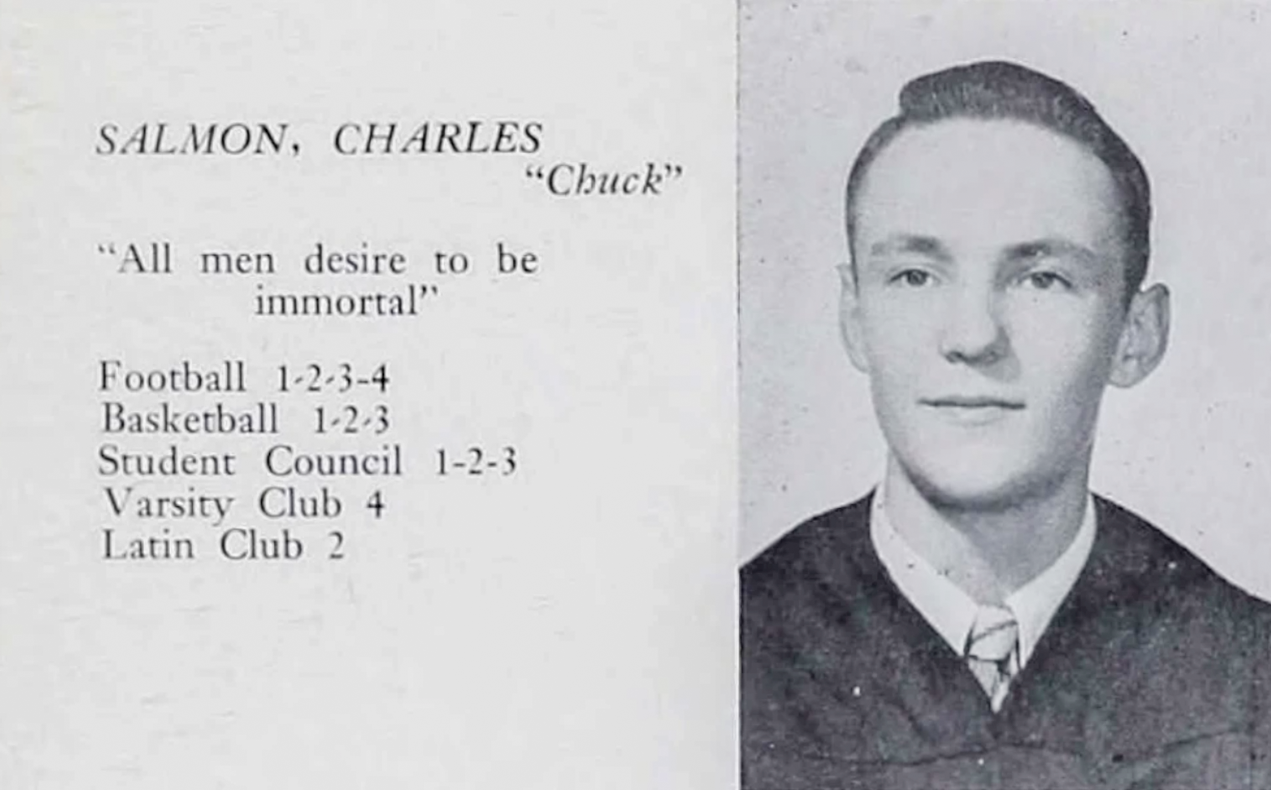
Charles “Chuck” Salmon in the 1947 Port Jervis High School yearbook.
Chuck was an athlete, broad-shouldered and competitive. At Williams College, he played offensive guard and defensive tackle on the football team, earning recognition as one of the leading linemen in New England. Teammates remembered him as hard-nosed and fearless. One later recalled that Chuck carried the mentality of a Golden Gloves boxer onto the field.
For a time he even roomed with George Steinbrenner, the future owner of the New York Yankees.
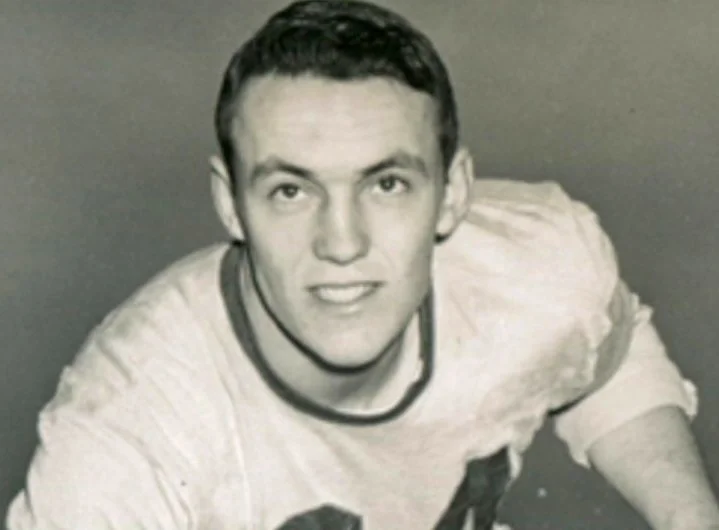
Chuck Salmon during his football career at Williams College in the early 1950s.
By the time Chuck graduated in 1952, three professional football teams invited him to try out. But he chose a different course.
Chuck accepted a commission as a second lieutenant in the U.S. Air Force through the ROTC program at Williams.
After flight training he began flying the F-86 Sabrejet, one of the most advanced fighter aircraft of its time. Among the pilots he flew with, the name Chuck slowly disappeared.
They called him Fish.
The Yellow Sea
On Feb. 5, 1955, Fish Salmon was flying an F-86 Sabrejet over the Yellow Sea.
Just three years earlier he had graduated from Williams.
Now his flight was escorting an RB-45 reconnaissance bomber — a four-engine jet heading south over international waters about 10 miles off the North Korean coast. The aircraft cruised at 30,000 feet on what the Air Force described, with characteristic understatement, as “its usual reconnaissance mission.”
The bomber droned steadily south through clear sky.
Then, at 1:40 in the afternoon, eight Soviet-built MiG-15 fighters swept into view.
Sabres against MiGs — one of the defining aerial rivalries of the Korean War era.
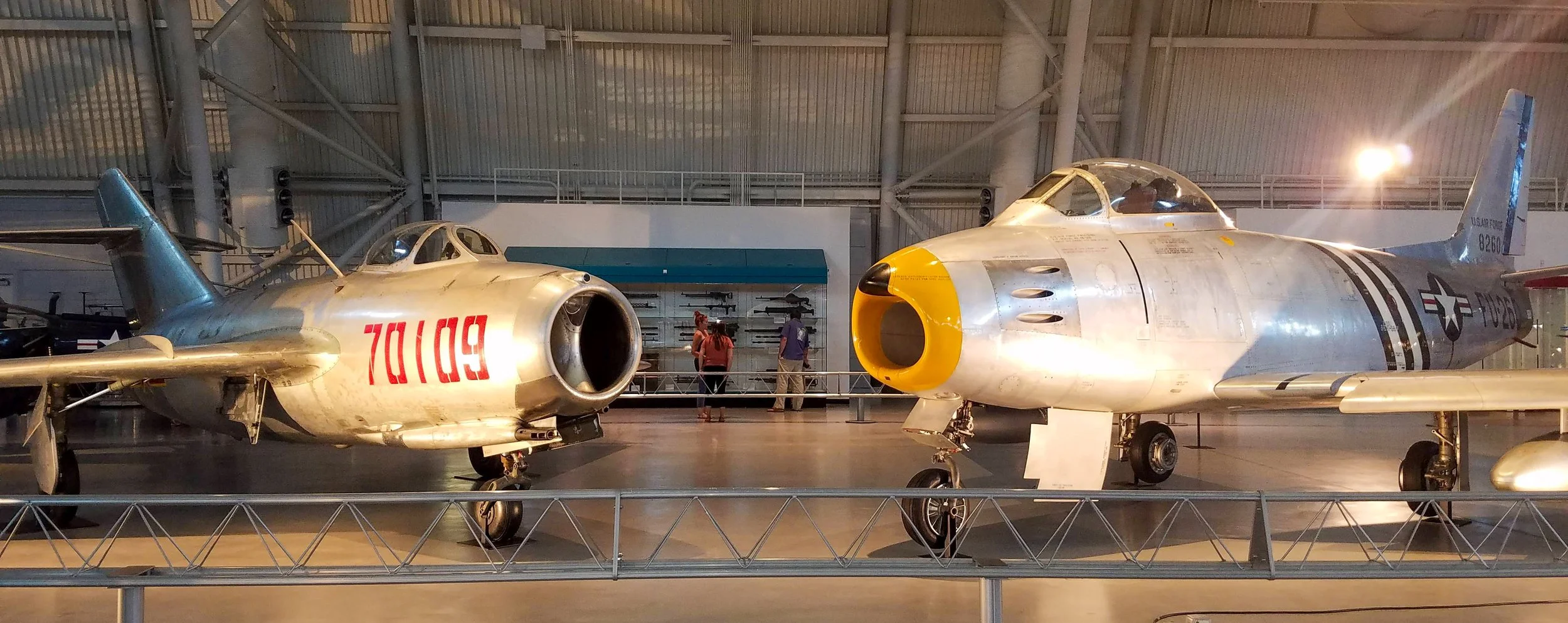
Cold War rivals on display at the Smithsonian’s National Air and Space Museum: a Soviet-built MiG-15 (left) and an American F-86 Sabrejet (right).
Four of the MiGs dropped toward the reconnaissance plane while the other four came straight for the escorts.
“They attacked from above and behind us,” Salmon later told reporters. “The first indication I had was when I saw cannon shells streaking toward the bomber like so many red balls.”
The sky around him lit up.
Salmon flipped his Sabre onto its back and dropped in behind the attackers.
“I rolled over and got on the tail of one of the MiGs,” he said. “I set the pipper on him and gave him five or six bursts.”
The fighter began to smoke. A moment later, it caught fire and fell toward the sea.
Another Sabre pilot, Capt. George Williams of Austin, Texas, shot down a second MiG. The remaining fighters broke away and headed north.
The whole encounter lasted only minutes.
“It’s like training two and a half years for a foot race,” Salmon said afterward. “When the race finally comes off, you don’t have time to think about it much or to get excited.”
All of the American aircraft returned safely to base.
Salmon was credited with destroying one MiG and assisting in the destruction of another. For his actions that day, he received the Distinguished Flying Cross.
The attraction in Florida
Newspapers that reported the dogfight carried another story as well.
In Palm Beach, Florida, a 24-year-old woman named Harriet Paul was fielding phone calls from reporters.
Harriet worked in a real estate office. She had known Chuck Salmon most of her life. Their mothers had met years earlier in Pittsburgh and stayed in touch, which was how the two families first became connected.
Now she was suddenly being asked about the fighter pilot who had just shot down a MiG over the Yellow Sea.
“It’s been exciting,” she told a reporter from The Miami News. “But I’d rather think about the time when he comes home.”
Not long before the fight, Chuck had written home.
“The flying is terrific and the whole gang is the best I ever hoped to be with,” he wrote. “I hate to leave my present outfit but the attraction in Florida is too terrific.”
The attraction was Harriet.
Later that year, he came home.
Chuck and Harriet were married in Palm Beach later that year. The following summer, their daughter, Perrie, was born on the Fourth of July.
Chuck was 26.
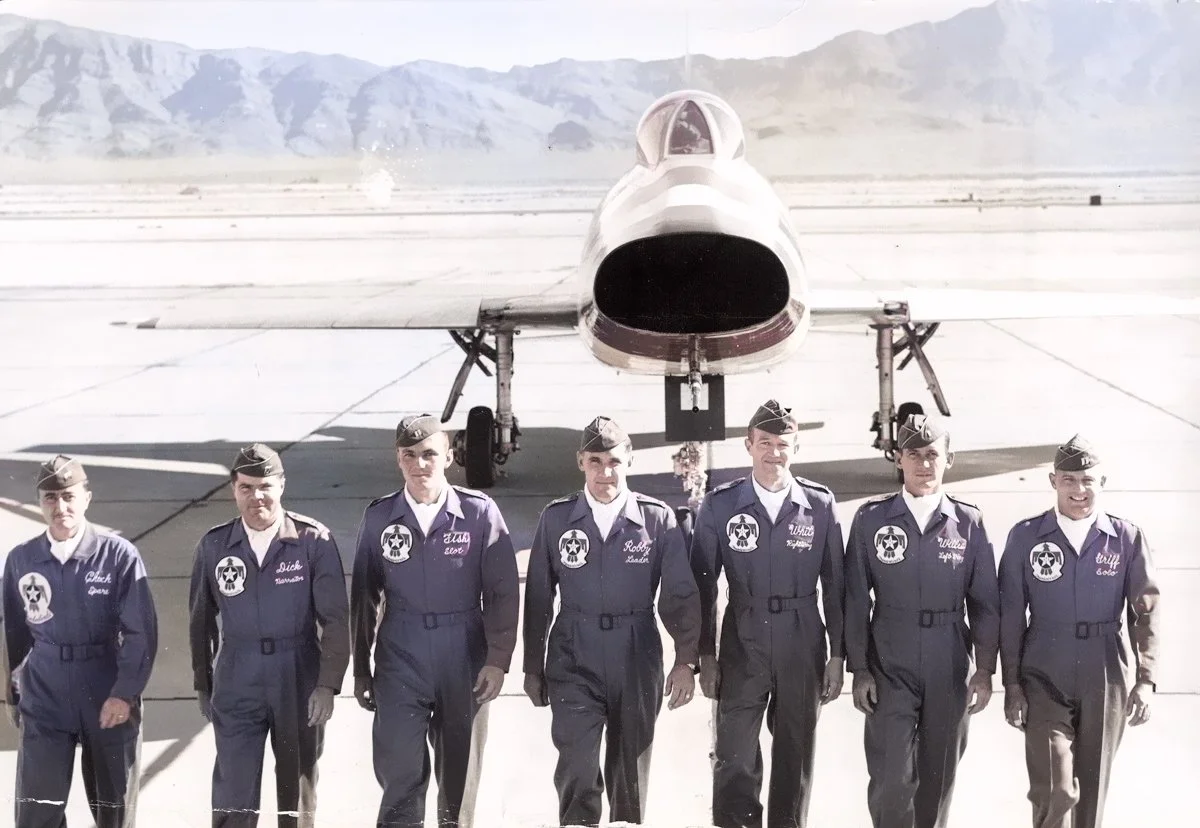
Members of the U.S. Air Force Thunderbirds pose in front of an F-100 Super Sabre at Nellis Air Force Base in 1958. Capt. Charles “Chuck” Salmon, known to fellow pilots as “Fish,” stands third from the left.
The Thunderbirds
Chuck was still flying fighters for the Air Force.
In January 1958, he was selected for the Thunderbirds, the service’s elite aerial demonstration squadron based at Nellis Air Force Base outside Las Vegas.
Harriet and Perrie moved west with him.
The Thunderbirds are among the Air Force’s most visible teams. Flying F-100 Super Sabre jets, the team performed aerial demonstrations across the country, showcasing speed, precision, and absolute control in tightly choreographed formations.
Crowds gathered at airfields to watch the aircraft roar overhead in perfect alignment, crossing and climbing in maneuvers that left almost no room for error.
Chuck flew the slot position, tucked directly behind the lead jet in the diamond formation. From the ground, the formation looked effortless, the planes moving as if connected. In reality, the pilots held their positions only a few feet apart while traveling hundreds of miles an hour.
It demanded extraordinary concentration and steady nerves.
Chuck seemed built for it.
For the public, he was now Capt. Charles D. Salmon, Thunderbird pilot.
To the pilots beside him in the formation, he was still Fish.
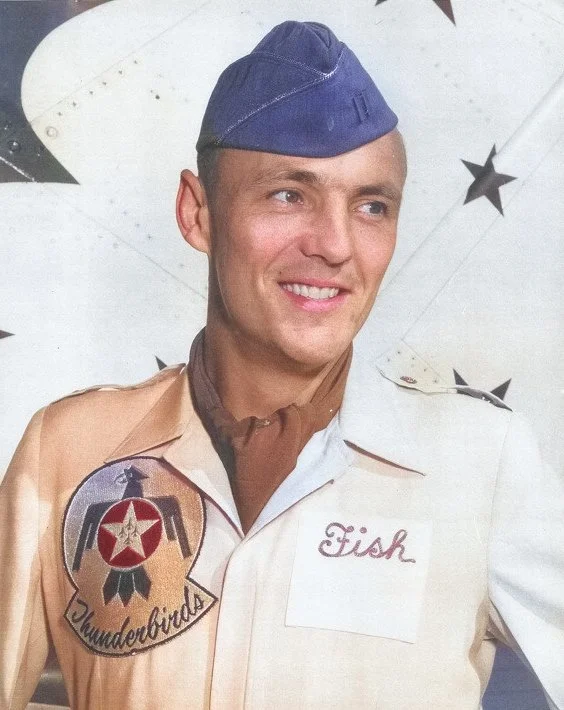
Capt. Charles “Fish” Salmon during his time with the Thunderbirds.
Years later the Salmon family would tell another story about Chuck’s flying.
He arranged to pass over Twin Lakes, where his parents kept a summer house along the water’s edge. At the appointed time, the family hurried out to the dock and looked up.
A jet roared across the sky.
Fish Salmon was at the controls.
For a moment, the aircraft streaked over the lake — a flash of speed and thunder overhead — before disappearing into the distance.
Stories like that still circulate in the Salmon and Mathieson families.
The football captain. The MiG dogfight. The Thunderbird pilot.
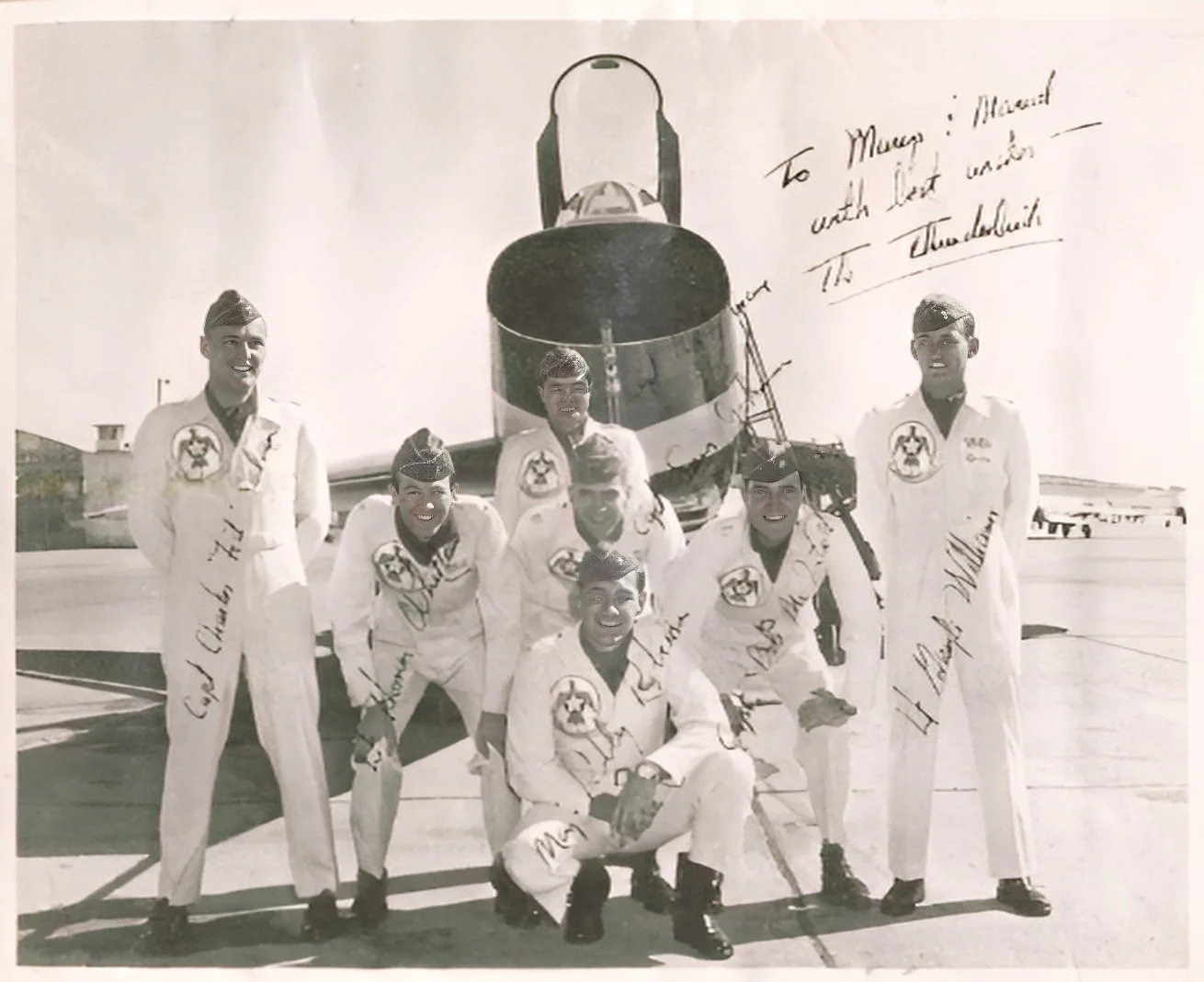
Capt. Charles “Chuck” Salmon, far left, poses with fellow U.S. Air Force Thunderbird pilots
The last flight
On March 12, 1959, the Thunderbirds were practicing over the Nevada desert.
Chuck was flying his usual position — the last point in the diamond formation.
During the flight, his aircraft collided with another jet in the formation. Following procedure, Chuck climbed to 30,000 feet and ejected.
He was only 30 years old.
The news moved quickly through the nation’s newspapers. In Florida and Pennsylvania, it was front-page news.
At Nellis Air Force Base, where the Thunderbirds were based, a road would later be named in his honor: Salmon Drive.
In the years that followed, the stories about Chuck continued to circulate in the Salmon, Mathieson, and Harrison families — the way stories do when a life refuses to fade.
The football captain from Port Jervis.
The fighter pilot who once dropped in behind a MiG over the Yellow Sea.
The Thunderbird who streaked low over Twin Lakes while the family watched from the dock.
For the people who knew him, the stories never really stopped.
Chuck.
Fish.
In that way, perhaps, the old yearbook line turned out to be true.

Salmon Drive at Nellis Air Force Base in Nevada, named in honor of Thunderbird pilot Capt. Charles D. Salmon.