The Snow at the Palisade
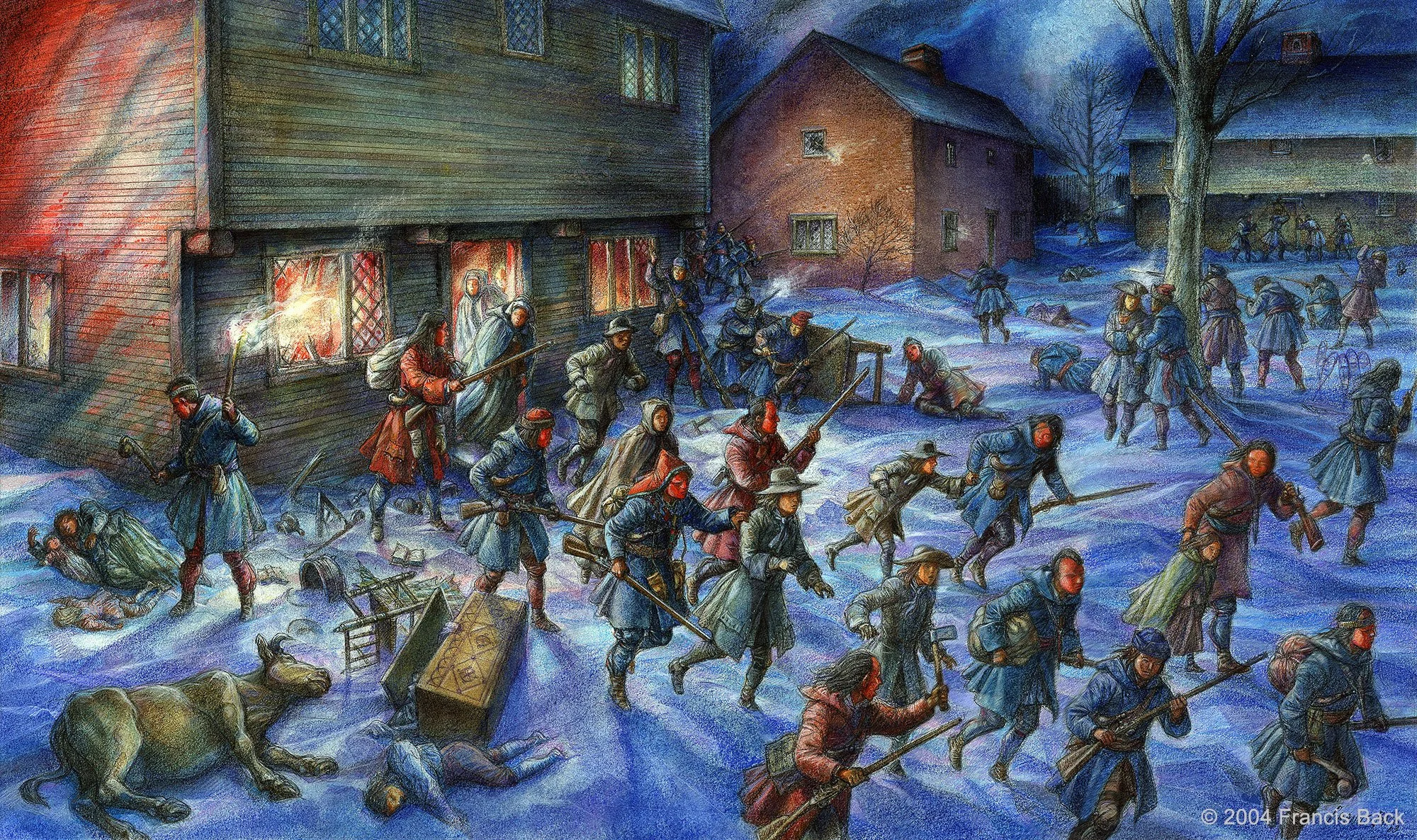
A modern historical illustration by Francis Back depicts the predawn attack on Deerfield, Massachusetts, on Feb. 29, 1704.
For days, the snow had been falling.
Smoke from 40-odd chimneys braided into the cold air above Deerfield. The town pulled inward for winter. Cattle were brought close. Gates were barred.
Along the wooden palisade surrounding the western Massachusetts settlement, drifts had grown into a second wall — higher, softer, treacherous, nearly reaching the top.
Quiet settled heavily over the town, but no one mistook it for safety.
During the war between England and France — Queen Anne’s War — the Connecticut River valley lay exposed. French officers in Canada encouraged raids south. Native allies moved through the winter woods with skill and speed the English could not match.
Frontier towns like Deerfield had reason to worry.
On the night of Feb. 28, 1704, a force of roughly 250 men moved through the snow outside the village — French soldiers, Canadian militia, and Native warriors — all led by Jean-Baptiste Hertel de Rouville, an officer in the service of New France.
They reached the palisade before dawn.
The drifts against the wall had hardened in the cold. The raiders climbed them like ramps and within minutes were inside. The first musket shots split the dark.
Doors splintered under hatchets and musket butts. One such door still survives in Deerfield, its wood marked by the blows struck that morning.
The sound cracked through timber and frozen air. More shots followed. Then shouting — French, and words many inside the stockade could not understand.
Men ran toward the noise, muskets half primed. Others froze, unsure where the breach had come. Snow kicked up under boots as figures moved between houses.
Fire caught fast in the dry beams. A barn went first. Then a roof. Light flared against the palisade and turned the snow a hard, unnatural orange.
At a house near the center of the village, the door gave way under repeated blows.
The house belonged to Godfrey Nims, my eighth great-grandfather.
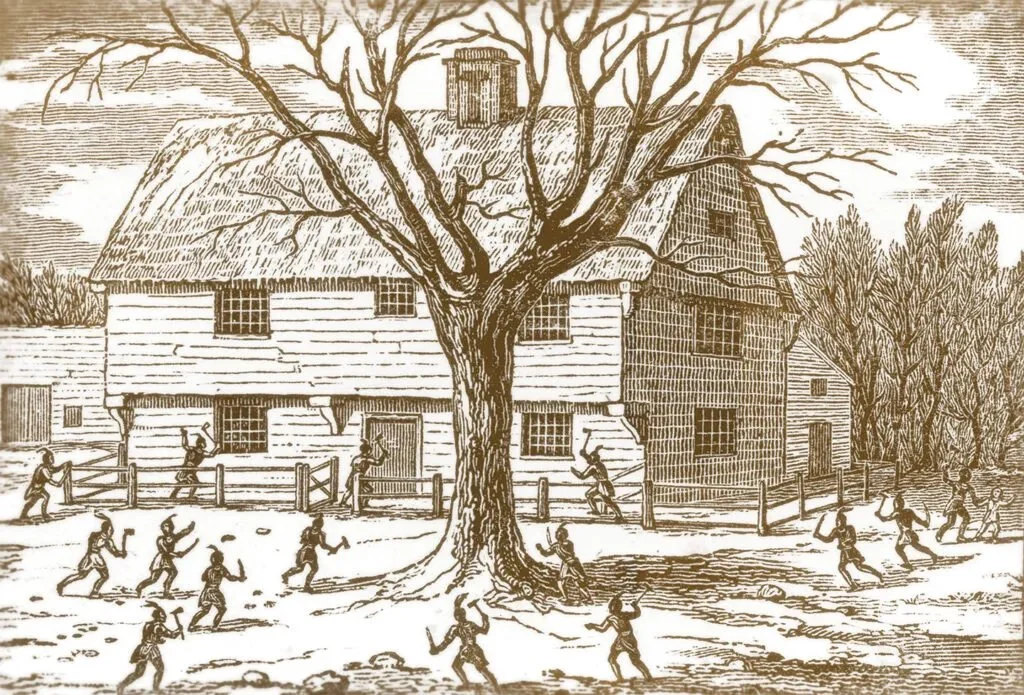
Attackers surround the house of Deerfield minister John Williams in this engraving from the frontispiece of “The Redeemed Captive,” his famous account of the rai.
Before the wall
Godfrey Nims didn’t arrive in Deerfield by accident.
The earliest known record of him appears in a court proceeding from Springfield, Massachusetts, dated Sept. 24, 1667. He was a boy then — described simply as a “lad.” Along with two companions, James Bennet and Benoni Stebbins, he had broken into a neighbor’s house while the owner attended church. The boys stole silver coins and wampum, intending, they confessed, to use the money to pay a local Native to guide them to Canada.
The court was not amused. The boys were ordered whipped on their bare backs, probably in full view of the community, and made to repay the stolen money threefold.
What became of the others is less clear. By the 1670s, however, Godfrey Nims had moved north along the Connecticut River to Deerfield, the small and vulnerable frontier settlement.
The land had once been known as Pocumtuck, home to Native communities long before English colonists arrived. Many of Deerfield’s early settlers were young men of limited means, willing to risk life on the frontier in exchange for land and opportunity. By the time Godfrey settled there, it was a village of about 300 people clustered inside a wooden palisade.
Deerfield had known danger before. During King Philip’s War in the 1670s, the town had been attacked and briefly abandoned. Later conflicts brought more raids, ambushes, and threats along the frontier. For decades, Deerfield remained the northwesternmost English settlement in Massachusetts.
Life in the farming village followed the rhythm of the river valley.
The community was also deeply religious. The settlement belonged to the Puritan world of New England, where church and community were closely bound. A meetinghouse stood near the center of town, and sermons framed the dangers of frontier life as both earthly and spiritual trials.
Fields of corn and rye stretched beyond the stockade. The rich intervale soil of the valley — renewed by the periodic flooding of the Connecticut River — made it some of the most fertile land in New England.
Livestock grazed the meadowlands. Work changed with the seasons: planting in spring, harvest in fall, cutting timber, repairing tools, preserving food for winter.
Most goods were made or mended at home.
Godfrey’s trade was cordwainer — a shoemaker. It was practical work in a settlement where boots wore thin quickly and replacements were scarce. Over time, he acquired additional land and built a house inside the stockade.
He married twice and raised a large blended family.
In 1694, not long after his marriage to widow Mehitable (Smead) Hull, disaster struck the household. One of the children accidentally set fire to a flax bed with a candle during the night. The house burned, and one of Mehitable’s sons died.
Godfrey rebuilt on the same site.
By the early 18th century, he had become one of Deerfield’s established residents. His household included grown sons working the land and younger children still at home.
One of those sons was John, my seventh great-grandfather.
October 1703
Just four months before the deadly raid on Deerfield, 24-year-old John Nims was bringing cattle in from pasture when the men stepped out of the trees.
The fields lay beyond the stockade along the river meadow. Work like this — moving livestock before dark — was routine. It required no musket at the shoulder, only a stick and a practiced eye.
The men who emerged were not neighbors.
A small party of Native raiders had moved quietly through the woods north of town. They had watched the fields. They knew who ventured out alone.
John and his stepbrother Zebediah Williams were taken quickly.
There was no extended fight recorded. No heroics. They were disarmed and led away before help could reach them.
Within hours, they were being marched north.
Captivity raids were a calculated feature of this border war. Prisoners could be exchanged for ransom, adopted into Native communities to replace lost kin, or used as leverage in negotiations between French and English authorities. Winter offered advantages. Rivers froze. Snow made travel easier than summer undergrowth.
English settlements scattered along the Connecticut River lay exposed along those routes.
John would eventually be taken near Montreal. Zebediah was forced farther north to Quebec.
By the time snow began to gather against Deerfield’s palisade in February, John was already gone.
The rest of his family was not.
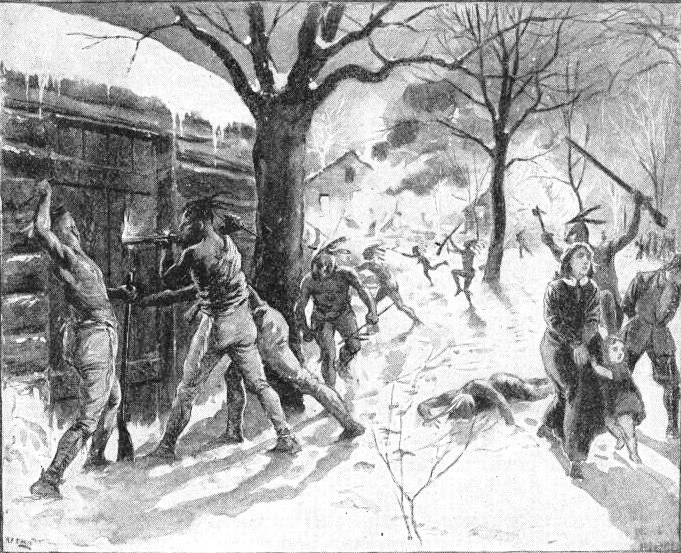
An early 20th century illustration by Walter Henry Lippincott depicts the predawn raid on Deerfield.
The Raiding Party
The raid on Deerfield did not emerge from the winter woods by chance.
It was organized in Canada by Jean-Baptiste Hertel de Rouville, a Canadian officer from a family long accustomed to frontier war.
Rouville had been born in 1668 in the Quebec town of Trois-Rivières, into a military family that had spent decades fighting along the northern frontier.
He had grown up in the world of winter raids and forest fighting. As a young man, he had followed his father on expeditions against the Seneca and in attacks along the New England frontier. Surprise assaults on isolated settlements were a tactic the Hertels had helped refine — small forces moving quickly through the wilderness, striking without warning, then disappearing again into the forests.
That winter, he assembled a raiding party of roughly 250 men — about 50 French soldiers and Canadian militia, accompanied by some 200 Native allies including Abenaki, Huron, Mohawk, and even some Pocomtuc whose people had once lived in the Deerfield valley.
The raid was intended partly as reprisal. Abenaki communities in northern New England had recently been attacked by English forces, and their leaders asked the governor of New France, Philippe de Rigaud de Vaudreuil, for support. Rather than target a fortified town, the raiders set out in search of a vulnerable frontier settlement.
In late February, after weeks of travel through deep snow and frozen forests, they reached the outskirts of Deerfield.
They waited for darkness.
And for snow.
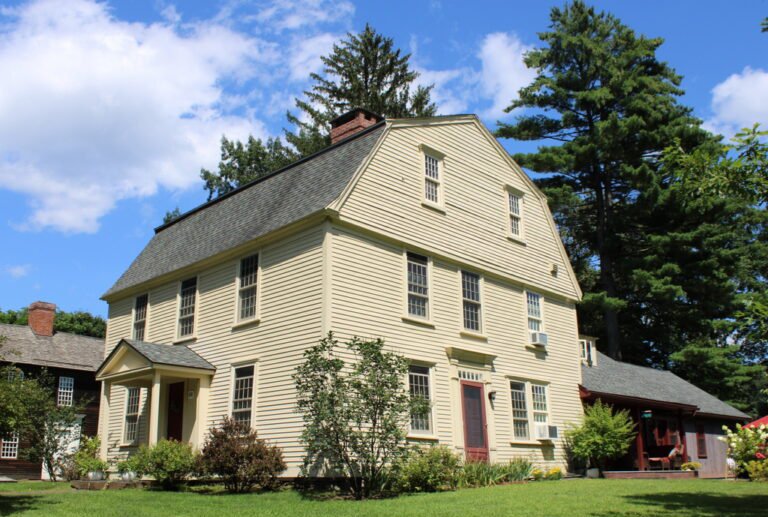
The Nims House at 58 Old Main Street in Deerfield, photographed in 2023. The current structure stands on the site of the earlier home owned by Godfrey Nims, which was burned during the 1704 raid.
The House
At the Nims house near the center of the settlement, the door gave way under repeated blows.
Raiders forced their way inside.
Gunpowder flashed white in the dark room. Smoke thickened beneath the rafters. Someone fell. Someone screamed.
Godfrey Nims had spent part of the night on guard inside the stockade, helping defend the town as the attack unfolded along the palisade. By the time he fought his way back through the smoke toward his own house, the violence had already reached his family.
Inside, the destruction was swift.
Three of his daughters died in the burning house — Rebecca, 24, Mehitable, 8, and Mercy, 6. A son Henry, 22, was killed in the attack.
Outside, raiders drove captives into the street — women pulled from beds, children crying barefoot in the snow. Those who resisted were struck down. Those who faltered were forced forward at gunpoint.
Among the prisoners forced from the Nims household was Godfrey’s wife, Mehitable. She was only 36.
Members of the extended family were also taken, including Godfrey’s daughter Mary Williams, her husband, and their children.
Mary would not survive the journey north. Several days into the march, after a fall on the ice and a miscarriage during the night, she told the town’s minister — himself a captive — that she believed she would not live to see another day. She was killed along the trail soon afterward.
Back in Deerfield, one member of the Nims household had escaped the raiders entirely.
Godfrey’s daughter Thankful and her new husband, Benjamin Munn, had taken shelter in a small dwelling buried deep beneath the snow. Hidden from the attackers, they remained undiscovered.
By midmorning, the attack was over.
Seventeen houses had been destroyed. Fifty-six men, women, and children lay dead in the snow. More than a hundred others — nearly a third of Deerfield’s population — had been taken captive and were already being driven north toward Canada.
The Nims household was nearly gone.
Godfrey himself survived the attack, but the family he returned to find had been shattered.
Before the embers cooled, the captives were already on the move. The column passed through the shattered gate and onto the frozen road leading north.
The journey ahead stretched nearly 300 miles through forest and frozen rivers. Men, women, and children walked north under armed guard through deep snow and bitter cold. Some would be exchanged and return to New England. Others would be adopted into Native communities or remain in Canada for the rest of their lives.
Among those marching into the winter were members of the Nims family.
One son, however, was already on that road.
Months earlier, John Nims had been taken along the same wilderness routes, moving north through the same frozen valleys toward Canada. When the raiders broke through the door of his family’s house that February morning, he was already on the road to Montreal.
The Long Aftermath
John Nims remained in captivity for nearly two years.
In May 1705 he escaped with three other prisoners and began the long journey back to Deerfield. They arrived weeks later, exhausted and emaciated.
Only then did John learn the full story of what had happened to his family.
His father had died in March of that same year, just weeks after the raid.
Many of his siblings and step-siblings were dead or scattered in captivity.
John survived the raid on Deerfield for a simple reason.
When the snow carried the raiders over the palisade that morning, he was already gone.
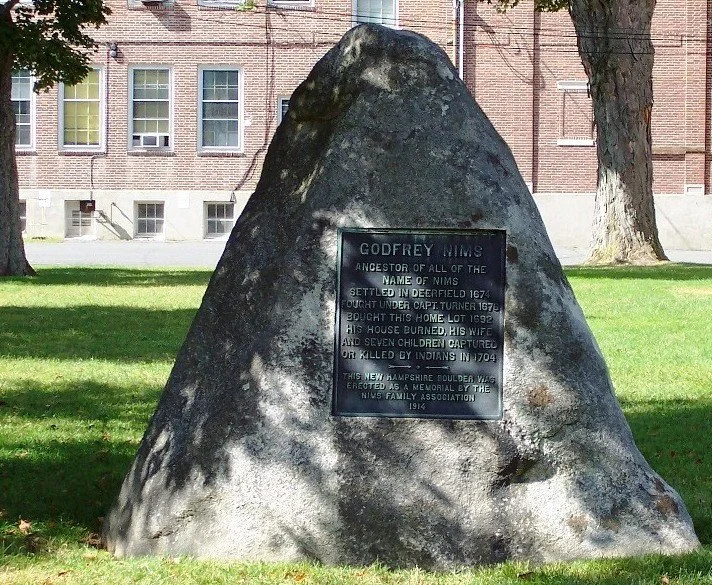
The Godfrey Nims memorial boulder in Deerfield, photographed in 2023. The 7-ton granite stone was dedicated Aug. 13, 1914, by the Nims Family Association. The bronze plaque recalls his arrival in Deerfield in 1674 and the devastation of the Feb. 29, 1704, raid. The boulder, brought from Roxbury, New Hampshire, stands on land that was once part of the original Nims homestead near Old Main Street.